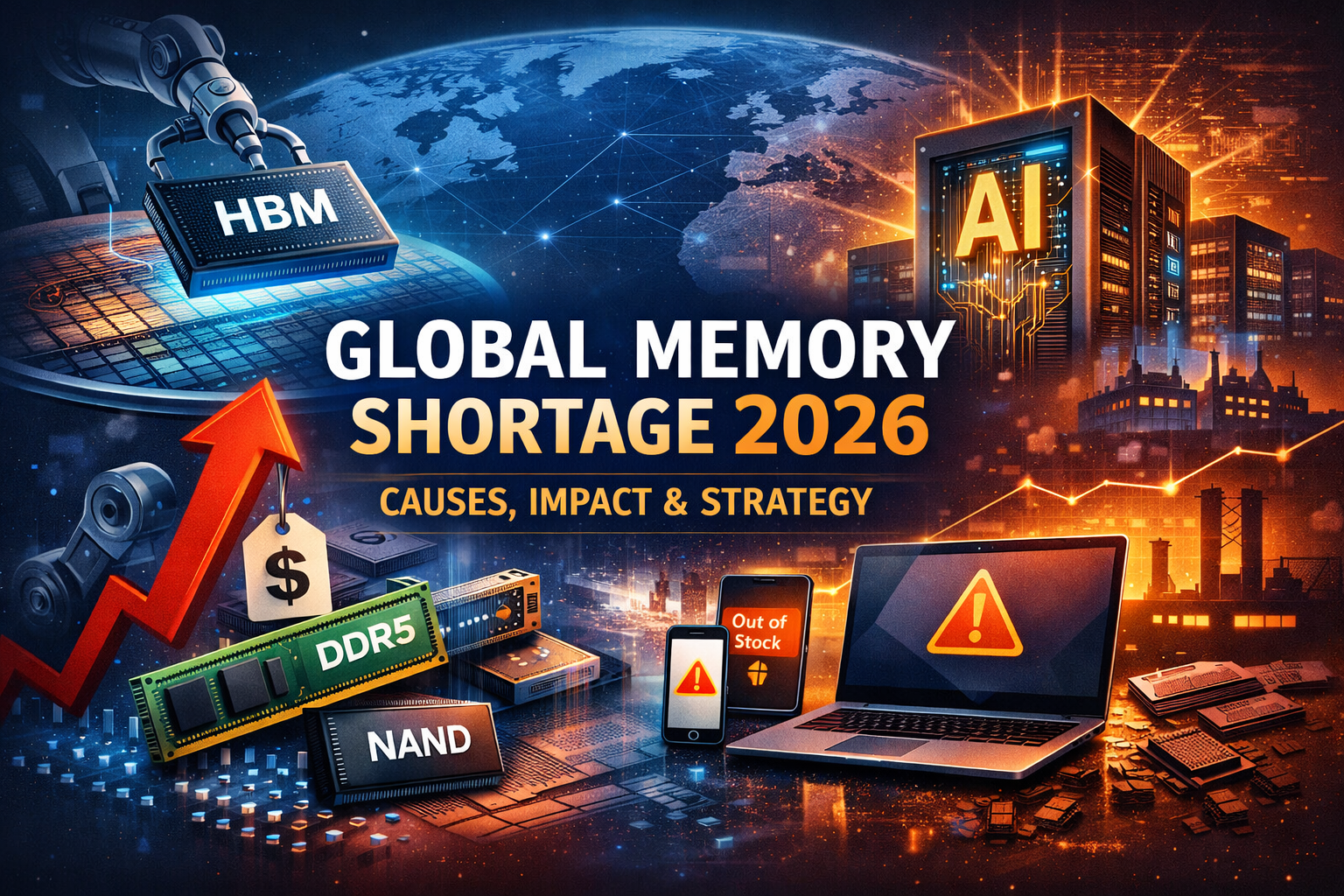
The global memory shortage that began intensifying in November 2025 continues to disrupt the technology industry - and its impact on end-user devices is becoming increasingly severe.
This is not a routine pricing cycle. It is a structural supply imbalance driven by AI infrastructure demand, manufacturing reallocation, and constrained wafer capacity. The consequences are already visible in DRAM pricing, NAND availability, enterprise SSD supply, and device cost resets across the market.
Understanding the gravity of this situation and acting quickly is essential.
1. What Is Causing the 2026 Global Memory Shortage?
AI Infrastructure Is Absorbing Memory at Unprecedented Levels
Hyperscalers and cloud providers are locking in long-term supply contracts to support massive AI data center buildouts. High-bandwidth memory (HBM), required for AI accelerators and GPUs, is now the primary bottleneck in semiconductor production.
HBM manufacturing is wafer-intensive, consuming significantly more production capacity than conventional DRAM. As suppliers prioritize HBM and server-grade DDR5, output of commodity DRAM (DDR4, DDR5 SODIMMs) and mobile LPDDR is structurally reduced.
This reallocation is intentional and strategic.
It is not temporary.
Manufacturers Are Shifting Toward Higher-Margin Segments
Memory producers are prioritizing:
-
HBM3E and HBM4
-
Server DDR5 RDIMMs
-
Enterprise-grade DRAM
This reduces availability for:
-
Consumer DRAM
-
Laptop SODIMMs
-
Entry-level SSD configurations
-
Standard enterprise notebooks and workstations
At the same time, enterprise SSD demand for AI servers is tightening NAND supply. Contract prices accelerated in late 2025, and industry trackers warn of potential inventory gaps into the first half of 2026.
The ecosystem is under structural pressure across DRAM and NAND.
2. What Are the Immediate Effects?
Sharp DRAM Price Increases
DRAM contract pricing rose approximately 50–55% quarter-over-quarter entering Q1 2026. This magnitude of increase reshapes OEM cost structures and forces pricing resets across devices.
Device Pricing Adjustments
Several OEMs have indicated device price increases of 15–20%. PC and smartphone average selling prices are rising up to 8%.
These adjustments are not speculative - they are tied directly to memory contract movements.
Extended Lead Times
High-density DDR5 server modules (96GB–128GB RDIMMs) are seeing lead times exceeding 20 weeks in some segments. Memory-intensive SKUs are under allocation control.
Configuration Changes
Some vendors are:
-
Increasing pricing on higher RAM configurations
-
Reducing base SSD capacities (e.g., 512GB → 256GB)
-
Limiting build-to-order customization
These are cost-containment responses to NAND and DRAM pressure.
3. How Severe Is the Situation?
The severity lies in its structural nature.
Unlike the 2020–2022 shortage driven by pandemic disruptions, today’s tightness is rooted in permanent manufacturing reprioritization toward AI memory.
2026 HBM capacity is largely sold out. Even as next-generation HBM4 enters mass production, demand continues to exceed supply.
Data center investment is accelerating and wafer capacity expansion takes years, not quarters.
Industry consensus suggests supply normalization is unlikely before late 2026 or 2027.
This is not a short-term spike.
It is a sustained shift.
4. What Should Organizations Expect in Q1-Q2 2026?
-
Continued DRAM contract volatility
-
Staged OEM repricing (mid-quarter and quarterly resets)
-
Allocation controls on memory-heavy SKUs
-
Ongoing NAND contract increases
-
Configuration mix adjustments
Organizations relying on predictable quarter-end purchasing cycles may face unexpected exposure to price resets or availability constraints.
5. How to Navigate the Memory Shortage Effectively
The most important takeaway: delay increases risk.
Here are practical recommendations to mitigate impact.
Plan Memory-Intensive Specifications Early
Devices with high RAM or large SSD configurations face the highest volatility and allocation pressure.
Forecast requirements further in advance than typical procurement cycles allow. Early commitment improves supply positioning.
Build Configuration Flexibility Into Planning
Where performance trade-offs are acceptable, consider:
-
Alternative RAM capacities
-
Staggered deployment schedules
-
Soldered-memory platforms with stronger allocation stability
Flexibility increases supply options and pricing leverage.
Avoid Last-Minute Quarter-End Orders
Multiple vendors are repricing mid-quarter based on DRAM and NAND contract movements.
Compressed decision windows increase exposure to unfavorable resets.
Engage Strategic Technology Partners Early
Suppliers working closely with upstream memory manufacturers can better advocate for allocation support when customer requirements are communicated early.
Waiting reduces influence.
The Bottom Line: Act Early or Absorb the Impact
The 2026 global memory shortage reflects a fundamental transformation of the semiconductor supply chain.
AI is not simply increasing demand - it is reshaping production priorities across DRAM, NAND, and HBM.
For organizations planning device refreshes, infrastructure expansion, or digital transformation initiatives, proactive planning is no longer optional.
The gravity of the situation requires:
-
Faster decision cycles
-
Earlier forecasting
-
Greater configuration flexibility
-
Stronger supplier engagement
Memory has become strategic infrastructure.
Those who move early will manage cost and continuity.
Those who wait may face allocation limits, extended lead times, and pricing volatility that could have been mitigated.
1评论